Introduction
We recently heard from a local fishing club about three large, dangerous ash trees on their grounds. Ash trees are often substantial trees – they have significant weight and reach, and there’s a risk a tree that size could cause serious damage if it were to fall naturally. These trees were positioned in a woodland setting where they posed a danger to other trees, plus there was the added risk to people with the nearby footpath being regularly used by members.
The club needed the trees removed safely, quickly and cleanly, without disruption to the surrounding trees, fencing and vegetation.
The Challenge
Ash trees across the UK have been in the spotlight in recent years, with ash dieback disease affecting an estimated 60 million trees nationwide, risking the future of the tree species and the many creatures that depend on ash trees for their habitat. Whether through disease, age or structural weakness, an unstable mature ash tree can be a serious hazard, as ash trees often grow to large sizes and can fall unpredictably. Whilst we’d always prefer to salvage a tree wherever possible, in some scenarios it’s impossible to avoid felling the tree. On this occasion, we needed to remove the trees to reduce the risks from sudden falling trees, but we were able to retain a portion of the trunk as a monolith to create a habitat for wildlife.
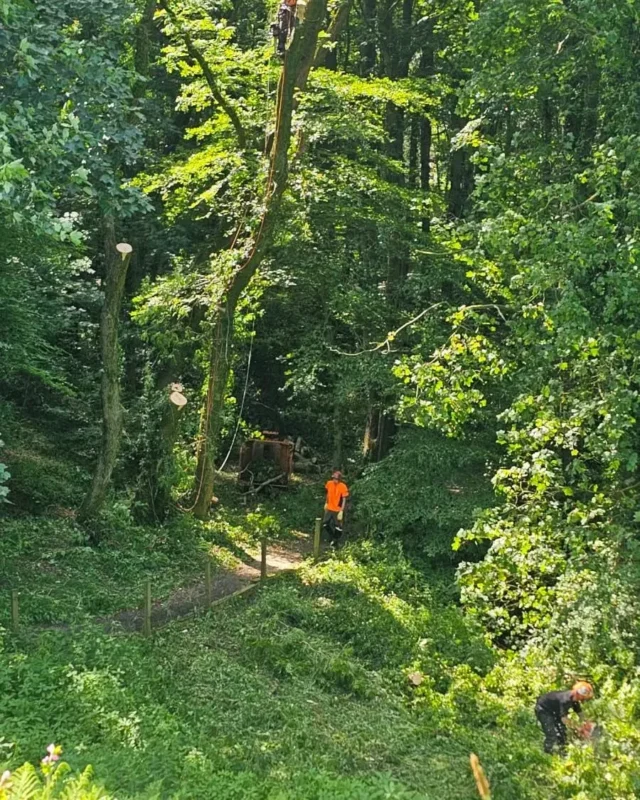
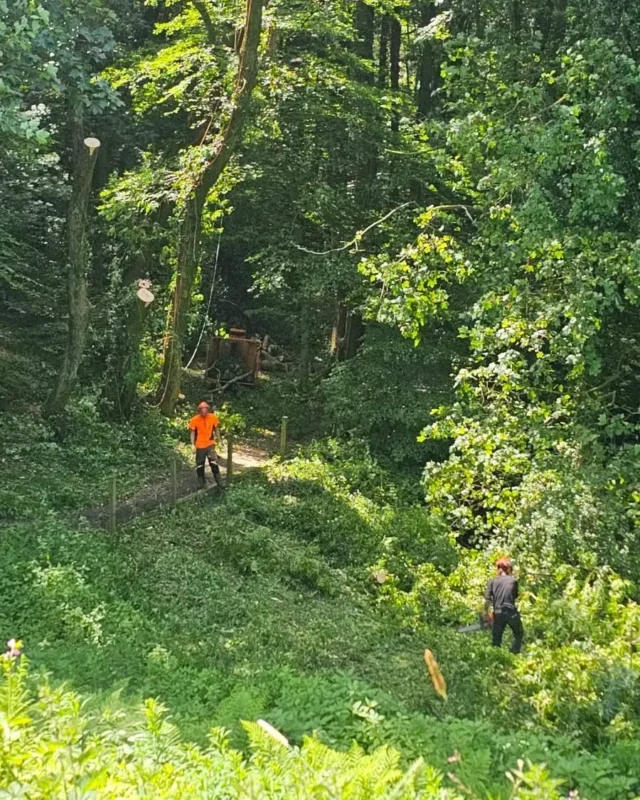
These trees came with an additional challenge beyond the size, as they were situated in dense woodland next to a frequently used footpath on the fishing club grounds. Due to the proximity of other trees, vegetation and fencing, there was no open space to safely direct falling timber.
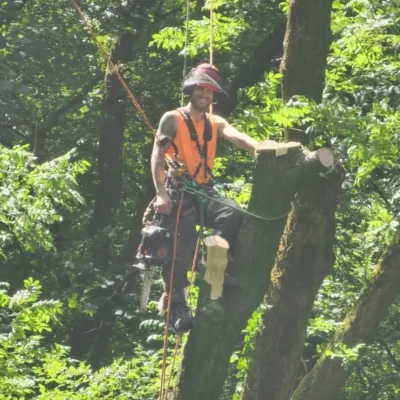
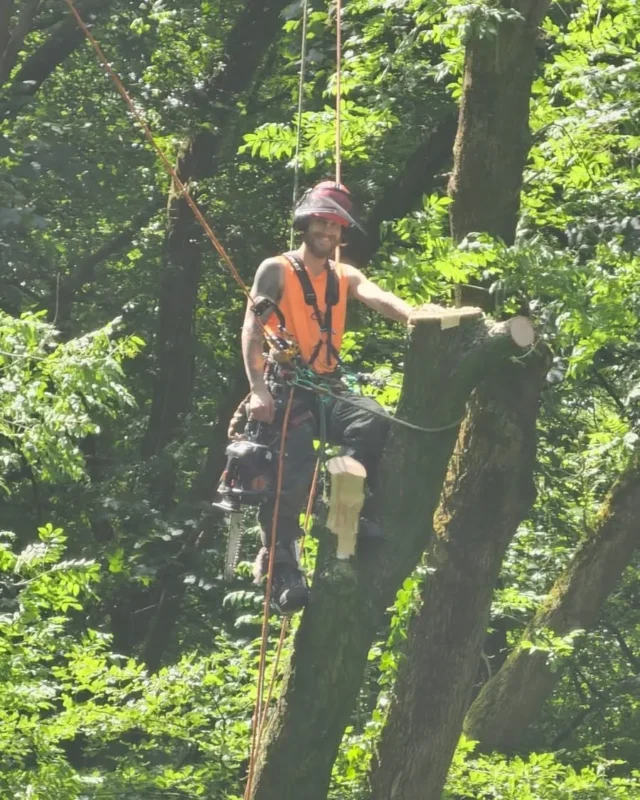
The safest option was to use sectional dismantling and work from the top down using our experienced climber in coordination with our ground crew to carefully lower any felled timber.
Our Approach
Before setting up any climbing equipment, our team performed an assessment and created a plan that would allow us to remove each tree safely. We evaluated the trunk’s structural integrity, identified the safest climbing route, and decided on a sequence of cuts working downwards from the crown. Getting the plan right before starting work is a key step in ensuring all our jobs can be completed both quickly and safely.
Once we had our rigging lines set and the ground team in position, we worked to strip down the canopy and expose the trunks. Our ground team were extremely important at this stage, as they managed the branches being removed and kept the area clear of obstructions using our trusty Först woodchipper. Once the trunks were stripped of branches, we were able to systematically dismantle the dangerous sections of the trees.
This top-down approach is the safest method for trees like these that are in restricted spaces. Rather than attempting to fell a whole tree in a risky uncontrolled fall, sectional dismantling lets us control each piece of timber safely to the ground. Additionally, it allows us to retain stable portions of the tree where possible, meaning we can remove the dangerous sections and leave the rest of the tree.
Work Carried Out
Our team carefully thinned out the dense stand of ash alongside the footpath, removing unstable crowns and overhanging limbs to make the route safer for the fishing club members. We were able to carry out targeted dismantling instead of removing the whole tree, making specific cuts that would leave a standing portion of stable timber. Leaving this deadwood monolith supports the local ecosystem by providing a habitat for birds, bats, insects and fungi – it’s especially important for ash trees, as several unique species rely on these threatened trees as a habitat. This approach reduced the risk from trees affected by ash dieback without stripping the bank bare, maintaining the natural character of the woodland.
Our team also conducted some brush clearance, thinning out overgrown shrubbery to allow sunlight to reach the woodland floor. This can encourage more plant growth, creating better habitats for insects and small mammals.
The Importance of Acting Quickly on Dangerous Trees
One of the most common things we hear from clients is that they’ve been meaning to get a tree looked at but haven’t got around to it yet. Whilst we understand that tree work often doesn’t feel urgent, dangerous trees usually don’t give notice before they fail. Branches can suddenly fall in calm conditions as well as during storms, and even a tree that looks stable from the outside may be damaged internally. For landowners and organisations with a duty of care to the public – such as fishing clubs, estates, sports grounds and commercial properties – delaying work on a known dangerous tree creates an additional liability risk.
Early intervention is always safer, simpler, and more cost-effective than waiting for a potentially dangerous tree to become a problem.
Conclusion
This ash tree removal for a local Lancashire fishing club is a good example of the difference between professional tree surgery and untrained work. Our skilled team were able to remove the dangerous branches whilst leaving the safe standing deadwood to support habitats, keeping the area safe for humans and wildlife.
If you have a tree on your property that’s giving you cause for concern, don’t put it off. Our team of NPTC qualified tree surgeons covers Lancashire and the surrounding areas, with the experience and equipment to handle dangerous tree removal safely in even the most challenging locations.
Get in touch with Highfield Tree Care today for a professional assessment and honest advice.